
Columbia University Medical Center researchers use mouse model to study schizophrenia
Article originally published in Columbia Spectator
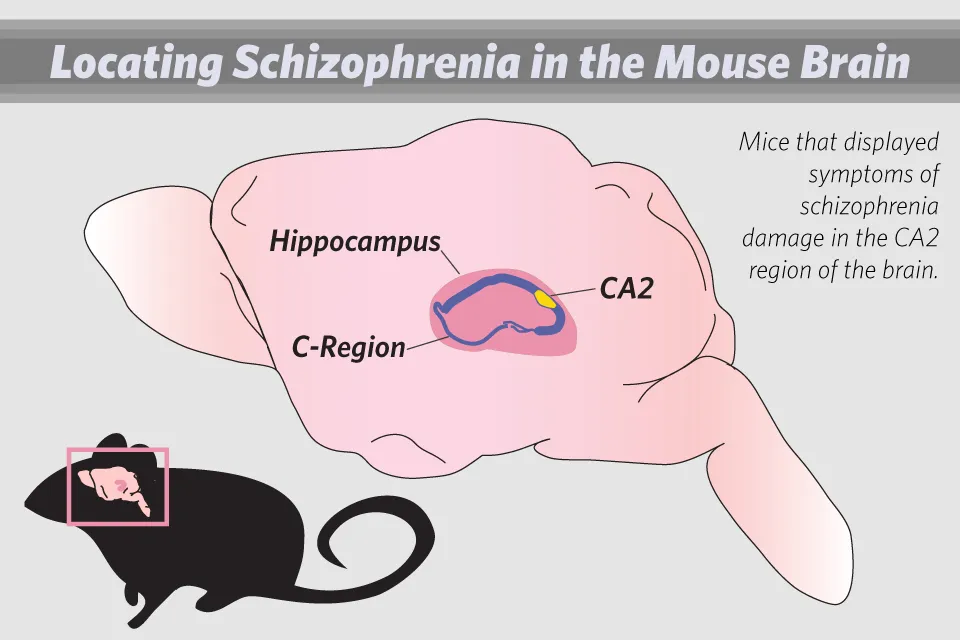
New Columbia-led research suggests that a long overlooked part of the hippocampus—a structure in the brain central to the formation of memories—may hold the answers to how disorders like schizophrenia come about.
Scientists from Columbia and Paris Descartes University used genetically engineered mice prone to schizophrenia to investigate how the CA2 region of the hippocampus was associated with psychiatric disorders.
Postmortem examinations of humans with schizophrenia have revealed abnormalities in the CA2 region of the hippocampus, which recent studies have linked to the formation of social memories.
“We put two and two together, and we explored this connection in this mouse model of schizophrenia,” co-lead author and professor of physiology and neuroscience Joseph Gogos said.
The study—published in Neuron earlier this month—found a decrease in the number of inhibitory neurons, which control impulses, in the CA2 area of genetically engineered mice.
These changes to the CA2 area could explain the mechanism behind the social symptoms of schizophrenia, and could potentially lead the way for more targeted and effective treatments, according to the researchers.
Around 3.5 million people in the United States have been diagnosed with schizophrenia. Those affected are typically associated with a few commonly known symptoms: delusions, hallucinations, and disorganized thought processes. But schizophrenia is also characterized by other symptoms, such as reduced concentration, inability to sustain relationships, and disengagement in daily life.
“There are some symptoms of schizophrenia that are impossible to model in mice like hallucinations and delusions,” Gogos said. “But there are other symptoms which are readily prominent in schizophrenia that are cognitive symptoms, which are pretty straightforward to replicate in mice.”
Currently, the roots of the social and cognitive symptoms of schizophrenia are largely unknown.
“People with schizophrenia tend to lead lives with limited close contacts,” John Krystal, a Yale professor of psychiatry who was not involved in the study, said. “We have a limited understanding of the neurobiology underlying these social deficits.”
To understand what causes those aspects of schizophrenia, the researchers compared genetically engineered mice—designed to have a genetic deletion similar to one shown to cause schizophrenia in some humans—to a control group of normal mice.
In the genetically engineered mice, researchers observed a reduced density of inhibitory neurons in the CA2 region of the hippocampus.
The inhibitory neurons are responsible for relaying signals across parts of the hippocampus. Without inhibitory feedback from the neurons in the CA2 region, the study reported disrupted activity from nearby areas of the hippocampus.
Model mice also displayed decreased social memory. When genetically engineered mice were exposed to the same mouse multiple times, the length of time for subsequent interactions did not decrease, whereas the normal mice had decreased subsequent interaction times with mice they had encountered before.
The timing of the development of abnormal CA2 characteristics and impaired social memory in the model mice also has implications in human schizophrenia.
In humans, symptoms of schizophrenia typically do not appear until their late teens to 20s.
Similarly, the genetically engineered mice did not display irregularities in the hippocampus or impaired social memory until early adulthood.
In the study, the authors highlighted the CA2 region of the hippocampus as warranting further research in relation to schizophrenia and other psychiatric diseases due to its effects on the genetically engineered mice.
Krystal said he agreed with the researchers and felt that the study showed promise for investigating the causes of schizophrenia.
“The social deficits in schizophrenia have been a great puzzle,” Krystal said. “This study suggests that it is going to be possible to work out the biology of this dimension of this disorder.”
Gogos said he hopes that understanding the mechanism behind the disease could lead to discovering more effective treatments.
“We would like to ... find the potential targets, molecules, channels, and other kinds of receptors that we could target to actually revert original deficits,” Gogos said. “This, of course, would reveal targets for development of pharmaceuticals to actually treat the symptoms of the disease, hopefully sometime in the future.”